The Most Sailing Essentials: A Quick Start Guide to Common Terms
If you’re curious about sailing, the first hurdle isn’t the wind—it’s the language. This bite-sized primer collects the essential terms you’ll hear aboard, from the direction of travel to the parts of the boat. Master these, and you’ll communicate clearly with your crew and set off on your voyage with confidence.
Published May 16, 2026
Updated May 16, 2026
By David Martinez

Introduction
If you’re curious about sailing, the first hurdle isn’t the wind—it’s the language. This bite-sized primer collects the essential terms you’ll hear aboard, from the direction of travel to the parts of the boat. Master these, and you’ll communicate clearly with your crew and set off on your voyage with confidence.
Direction and Position Fundamentals
Aft means toward the stern or rear of the boat, while ahead or forward signals movement toward the bow, the front of the vessel. Astern is the opposite of ahead, indicating movement toward the back. Leeward and windward describe directions relative to the wind: leeward is away from the wind, while windward faces the wind.
The Boat’s Core Components
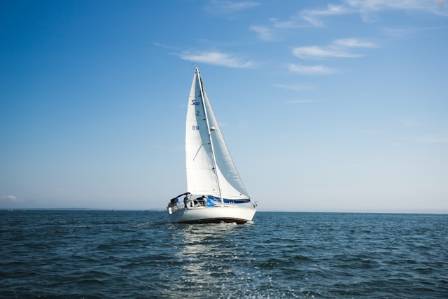
The hull is the boat’s main body, providing structure and buoyancy. The keel is the fin beneath the hull that helps balance the vessel in water. The rudder is the steering surface that directs the boat’s course. The mainsail is the large triangular sail attached to the boom, which runs along the bottom edge of the sail.
Sails and Rigging Essentials
The jib is the forward sail located ahead of the mast and typically without a boom. The mainsail and jib work together to harness the wind. The boom is the horizontal bar at the bottom of the mainsail, helping control its angle and shape.
Making Maneuvers: Tacking and Jibing

Tacking and jibing are the two basic ways to turn the boat relative to the wind. Tacking means turning the bow through the wind, shifting wind to the other side. Jibing (or gybing) is the opposite: turning the stern (rear) through the wind so the wind moves from one side to the other.
Everyday Nautical Terms
A nautical mile is a unit used at sea—one minute of latitude, roughly 6,076 feet. A square knot (reef knot) is a common way to join two lines of similar size. The term “port” refers to the left side of the boat when facing forward, and “starboard” refers to the right side. The stern is the back of the boat, the bow is the front, and “dead in the water” describes a vessel with no wind in its sails, unable to move.
Everyday Sayings to Know
Sailors use colorful phrases that still echo today. Phrases like “loose end,” “know the ropes,” “batten down the hatches,” and “get underway” capture practical actions and readiness for weather, maintenance, and journeys at sea.
Conclusion
With these basics, you’re on your way to speaking like a sailor and enjoying a safer, more enjoyable voyage. Practice these terms, join a sailing program, and soon you’ll be ready to set sail with confidence and a voice that matches the sea. Here’s to smooth currents and happy boating.